Lord Bacon
Onderstaand het artikel is afkomstig uit Chambers’s cyclopædia of English Literature, uitgebracht 1886.
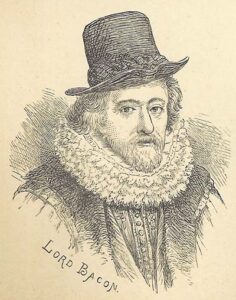
The greatest of English philosophers, Francis Bacon, was born in London on the 22d of January 1561. He was the youngest son of Sir Nicholas Bacon, lord-keeper of the great seal, by Ann, daughter of Sir Anthony Cooke, a lady of great learning and accomplishments, from whom het illutrious son may be said to have inherited his genius.
In childhood, Francis Bacon displayed such vivacity of intellect and sedateness of behaviour, that Queen Elizabeth used to call him het young lord-keeper. At the age of thirteen, he was sent to Trinity College, Cambridge, where he early became disgusted with the Aristotelian philosophy, which then held unquestioned sway in the great English schools of learning.
This dislike of the philosophy of Aristotle, as Bacon himself declared to his secretary, Dr. Rawley, he fell into, ‘not for the worthlessness of the author, to whom he would ever ascribe all high attributes, but for the unfruitfulness of the way, being a philosophy, as his lordship used to say, only, only strong for disputations and contentions, but barren of the production of works for the benefit of the life of man.’
After spending three years at Cambridge, he went to France, where he resided about three years, chiefly at Poitiers, pursuing closely his studies. His observations on foreign affairs were afterwards published in a work, entitled Of the State of Europe. By the sudden death of his father in 1579, he was compelled to return hastily to England, and engage in some profession. After in vain soliciting his uncle, Lord Burleigh, to procure mfor him such a provision from government as might allow him to devote his time to literature and philosophy, he spent several years in thje study of the law.
While engaged in practice as barrister, however, he did not forget philosophy, as it appears that he sketched at an early period of his life his great work, called The Instauration of the Sciences. In 1590, he obtained the post of counsel-extraordinary to the queen; and three years afterwards, sat in parliament for the county of Middlesex. As an orator, he is highly extolled by Ben Jonson. In one of his speeches he distinguished himself by taking the popular side in a question respecting some large subsidied demanded by the court; but finding that he had given great offence to her majesty, he at once altered his tone, and cndescended to apologise with that servility which unhappily appeared in too many of his subsequent actions.
To Lord Burleigh and his son, Robert Cecil, Bacon continued to pay court, in hope of advancement, till at length finding himself disappointed in that quarter, he attached himself to Burleugh’s rival, Essex, who, with all the ardour of a generous friendship, endeavoured to procure for him, in 1594, the vacant office of solicitor-general. In his attempt he was defeated, through the influence of the Cecils, who were jealous of both him and his friend; but Essex in some degree soothed Bacon’s disappointment by presenting him with an estate at Twickenham, which he afterwards sold for £1800.
It is painful to relate in what manner Bacon repaid such benefits. When Essex was brought to trial for a conspiracy against the queen, the friend whom he had so greatly obliged and confided in not only deserted him in the hour of need, but unnecessarily appeared as counsel against him, and by every art and ingenuity of a pleader, endeavoured to magnify his offence. He complied, moreover, after the earl’s execution with the queen’s request that he should write A Declaration of the Practises and Treasons attempted and committed by Robert, Earl of Essex, which was printed by authority.
Into his conduct, which indicates a lamentable want of high moral principle, courage, and self-respect, Bacon was in some measure led by pecuniary difficulties, into which his improvident and ostentatious habits, coupled with the relative inadequacy of his income, had plunged him. By maintaining himself in the good graces of the court, he hoped to secure that professional advancement which could at once improve his fortune and gratify his ambition. Such moral obliquity justified the antithesis which characterises him as
The wisest, brightest, meanest of mankind.
After the accesion of James, the fortunes of Bacon began to improve. He was knighted in 1603, and, in subsequent years, obtained successively the offices of king’s counsel, solicitor-general, judge of the Marshalsea Court, and attorny-general. This last appointment he received in 1613. In the execution of his duties, he did not scruple to lend himself to the most arbitrary measures of the court, and even assisted in an attempt to extort from an old clergyman, of the name of Peacham, a confession of treason, by torturing him on the rack.
Although his income had now been greatly enlarged by the emoluments of office and a marriage with the daughter of a wealthy alderman, his extravagance and that of his servants, which he seems to have been too good-natured to check, continued to keep him in diificulties. He cringed before the king and his favourite Villiers; and at length, on the 4th of January 1618-19, he attained the summit of his ambition, by being created Lord High Chancellor of England, and Baron Verulam. This latter title gave place in the following year to that of Viscount St. Albans.
As chancellor, it cannot be concealed that, both in his political and judicial capacities, he grossly deserted his duty. Not only did he suffer Villiers to interfere with his decisions as a judge, but, by accepting numerous presents or bribes from suitors, gave occasion, in 1621, to a parliamentary inquiry, which ended in his condemnation and disgrace. He fully confessed the twenty-three articles of corruption which were laid to his charge; and when waited on by a committee of the House of Lords, appointed to inquiere whether the confession was subscribed by himself, he answered: ‘It is my act, my hand, my heart: I besech your lordships to be merciful to a broken reed.’
Banished from public life, he had now ample leisure to attend to his philosophical and literary pursuits. Yet, even while he was engaged in business, these had not been neglected. in 1597, he published Meditations Sacre, a table of the Colours of Good and Evil, and ten Essays. In 1612, he reprinted the Essays, increased to thirty-eight; and finally, in 1625, he again issued them, ‘newly written,’ and now fifty-eight in number. These, as he himself says of them, ‘come home to men’s business and bosoms; and, like the late new halfpence, the pieces are small, and the silver is good.’ From the generally interesting nature of the subjects of the Essays, and their intrensic excellence, the work immediately acquired great popularity, and to the present day continues to be chosen companion of all students and thinkers. ‘It is,’ to use the words of Dugald Stewart, ‘one of those where the superiority of his genius appears to the greatest advantage, the novelty and edpth of his reflections often receiving a strong relief from the triteness of his subject. It may be read from beginning to end in a few hours, and yet, after the twentieth perusal, one seldom fails to remark in it something overlooked before. This, indeed, is a characteristic of all Bacon’s writings, and is only to be accounted for by the inexhaustible aliment they furnish to our own thoughts, and the sympathetic activity they impart to our torpid faculties.’
In 1605, he published another work, which still continues to be extensively perused; it is entitled Of the Proficience and Advancement of Learning, Divine and Human. This volume, which was afterwards enlarged and published in the Latin language, with the title De Augmentis Scientiarum, or the Instauration of the Sciences. The second part, entitled Novum Organum, is that on which chiefly his reputation as a philosopher is grounded, and on the composition of which he bestowed most labour. It is written in Latin, and appeared in 1620.
In the first part of the Advancement of Learning, after considering the excellence of knowledge, and the means of disseminating it, togehter with what had already been done for its advancement, and what omitted, he proceeds to divide it into the three branches of history, poetry, and philosophy, these having reference to what he considers ; the three parts of man’s understanding’- memory, imagination, and reason. The concluding portion of the volume relates to revelaed religion. The Novum Organum, which, as already mentioned, is the second and most important part of the Instauration of the Sciences, consists of aphorisms, the first of which furnishes a key to the author’s mleading doctrines: ‘Man, who is the servant and interpreter of nature, can act and understand no further than he has, either in operation or in contemplation, observed of the method – novum organum – of employing the understanding in adding to human knowledge, is fully expounded in this work.
After alluding to the little aid which the useful arts had derived from science, and the small improvement which science had received from practical men, he proceeds: ‘But whence can arise such vagueness and sterility in all the physical systems which have hitherto existed in the world?
It is not certainly from anything in nature itself; for the steadiness and regularity of the laws by which is governed, clearly mark them out as objects of certain and precise knowledge. Neither can it arise from any want of ability in those who have pursued such inquiries, many of whom have been men of the highest talent and genius of the ages in which they lived; and it can therefore arise from nothing else but the perverseness and insufficiency of the methods that have been pursued. Men have sought to make a world from their own conceptions and to draw from their own minds all the materials which they employed; but if, instead of doing so, they had consulted experience and observation, they would have had facts, and not opinions, to reason about, and might have ultimately arrived at the knowledge of the laws which govern the material world.’ ‘As things are at present conducted, a sudden transition is made from sensible objects and particular facts to general propositions, which are accounted principles, and round which, as round so many fixed poles, disputation and argument continually revolve.
From the propositions thus hastily assumed, all things are derived, by a process compendious and precipitate, ill suited to discovery, but wonderfully accommodated to debate. The way that promises succes is the reverse of this. It requires that we should generalise slowly, going from particular things to those which are but one step more general; from those to others of still greater extent, and so on to such as are universal. By such means e may hope to arrive at principles, not vague and obscure, but limunous and well defined, such as nature herself will not refuse to acknowledge.’
After describing the causes which lead the understanding astray in the search after knowledge – the idols, as he figuratively terms them, before which it is apt to bow – Bacon, in the second book of Novum Organum, goes on systematically to expound and exemplify his method of philosophising, indicated in the foregoing extracts, and to which the appelation of the inductive method is applied. This he does in so masterly a way, that he has earned with posterity the title of the father of experimental science.
‘The power and compass,’ says Professor Playfair, ‘of a mind which could form such a plan beforehand, and trace not merely the outline, but many of the most minute ramifications, of sciences which did not yet exist, must be an object of admiration to all succeeding ages.’
It is true that the inductive method had been both practised and even cursorily recommended by more than one philosopher prior to Bacon; but unquestionably he was the first to unfold it completely, to shew its infinite importance, and to indice the great body of scientific inquirers to place themselves under its guidance. In another respect, the benefit conferred by Bacon upon mankind was perhaps still greater. Het turned the attention of philosophers from speculations and disputes upon questions remote from use, and fixed it upon inquiries ‘productive of works for the benefit of the life of man.’ The Aristotelian philosophy was barren; the object of Bacon was ’the amplification of the power and kingdom of mankind over the world’ – ’the enlargement of the bounds of human empire to the effecting all things possible’ – the augmentation, by means of science, of the sum of human happiness, and the alleviation of human suffering. In a word, he was eminently a utilitarian, using that term in its enlarged sense, as comprehending the moral and intellectual, as well as the material welfare of man.
The third part of the Instauration of the Sciences, entitles Sylva Sylvarum, or History of Nature, is devoted to the facts and phenomena of natural science, including original observations made by Bacon himself, whichm though somtimes incorrect, are useful in exemplifying the inductive method of searching the truth. The fourth part is called Scala Intellectus, from its pointing out a succession of steps by which the understanding may ascend in such investigations. Other two parts, which the author projected, were never executed.
Another celebrated publication of Lord Bacon is his treatise, Of the Wisdom of the Ancients, 1610; wherein he attempts, generally with more ingenuity than success, to discover secret meanings in the mythological fables of antiquity. He wrote also Felicities of Queen Elizabeth’s Reign; a History of King Henry VII.; a philosophical romance called the New Atlantis; and several minor productions which is needless to specify.
After retiring from public life, Bacon, though enjoying an annual income of £2500, continued to live in so ostentatious and prodigal a style, that, at his death in 1626, his debts amounted to upwards of £22.000. His devotion to science appears to have been the immediate cause of his death. Travelling in his carriage wgen there was snow on the ground, he began to consider whether flesh might not be preserved by snow as wel as by salt. In order to make the experiment, he alighted at a cottage near Highgate, bought a hen, and stuffed it with snow. This so chilled him, that he was unable to return home, but went to the Earl of Arundel’s house in the neighbourhood, where his illness was so much increased by the dampness of a bed into he was put, that he died in a few days.
In a letter to the earl, the last which he wrote, after comparing himself to the elder Pliny, ‘who lost his life by trying an experiment about the burning of Mount Vesuvius,’ he does not forget to mention his own experiment, which says he, ‘succeeded excellently.’ In his will, the following strikingly prophetic passage is found: ‘My name and memory I leave to foreignnations, and to mine own country after some time is passed over.’
Bacon, like Sydney, was a ‘warbler of poetic prose.’ No English writer has surpassed him in fervour and brilliancy of style, in force of expression, or in richness and significance of imagery. Keen in discovering analogie where no resemblance is apparant to common eyes, he has sometimes indulged to excess in the excercise of his talent. Yet, in general, his comparisons are not less clear and apposite than full of imagination and meaning. He has treated of philosophy with all the plendour, yet none of the vagueness, of poetry. At times his style posesses a degree of conciseness, as well as force, rarely to be found in the compositions of the Elizabethan age.
A complete edition of the works of Lord Bacon, by James Spedding and others, in seven volumes, was published in 1870; and Mr. Spedding is also author of an elaborate Life of the philosopher, with a full collection of his Letters.
Friendship
It had been hard for him that spake it, to have put more truth and untruth together in a few words, than in that speech, ‘Whosoever is delighted in solitude, is either a wild beast or a god; m’ for its most true, that a natural and secret hatred and aversation towards society, in any man, hath somewhat of the savage beast; but it is most untrue, that it should have any character at all of the divine nature, except it proceed, not out of a pleasure in solitude, but out of a love and desire to sequester a man’s self for a higher conversation: such as is found to have been falsely and feignedly in some of the heathens – as Epimenides, the Candian; Numa, the Roman;m Empedocles, the Sicilian; and Appolonius, of Tyana; and truly, and really, in divers of the ancient hermits and holy fathers of the church. But little do men perceive what solitude is, and how far it extendeth; for a crowd is not company, and faces are but a gallery of pictures, and talk but a tinkling cymbal where there is no love.
The Latin adage meeteth with it a little: Magna civitas, magna solitudo [‘Great city, great solitude’]; because in a great town friends are scattered, so that there is not that fellowship, for the most part, which is in less neighbourhoods; but we may go further, and affirm most truly, that it is mere and miserable solitude to want true friends, without which the world is but a wilderness; and, even in this sense also of solitude, whosoever, in the frame of his nature and affections, is unfit for friendship, he taketh it of the beast, and not from humanity.
A principal fruit of friendship is the ease and discharge of the fulness and swellings of the heart, which passions of all kind do cause and induce. We know diseases of stoppings and suffocations are the most dangerous in the body, and it is not much otherwise in the mind: you may take sarze to open the liver, steel to open the spleen, flower of sulphur for the lungs, castoreum for the brain, but no receipt openeth the heart but a true friend, to whom you may impart griefs, joys, fears, hopes, suspicions, counsels, and whatsoever lieth upon the heart to opress it, in a kind of civil shrift or confession.
It is a strange thing to observe how high a rate great kings and monarchs do set upon this fruit of friendship whereof we speak – so great, as they purchase it many times at the hazard of their own safety and greatness: for princes, in regard of the distance of their fortune from that of their subjects and servants, cannot gather this fruit, except, to make themselves capable thereof, they raise some persons to be, as it were, companions, and almost equals to themselves, which many times sorteth to inconvenience. The modern languages give unto such persons the name of favourites, or privadoes, as if it were matter of grace or conversation; but the Roman name taaineth the true use and cause thereof, naming them participes curarum [‘participators in cares’]; for it is that which tieth the knot: and we see plainly that this hath been done, not by weak and passionate princes only, but by the wisest and most politic that ever reigned, who have oftentimes joined to themselves have called some of their servants, whom both themselves have called friends, and allowed others likewise to call them in the same manner, using the word which is received between private men …
It is not to be forgotten what Comineus observeth of his first master, Duke Charles the Hardy – namely, that he would communicate his secrets with none; and, least of all, those secrets which troubled him most. Whereupon he goeth on, and saith, that towards his latter time, that cleseness did impair and a little perish his understanding, Surely Comineus might have made the same judgment, also, if it had pleased him, of his second master, Louis XI, whose closeness was indeed his tormentor. The parable of Pythagoras is dark, but true, Cor ne edito – eat not the heart. Certainly, if a man would give it a hard phrase, those that want friends to open themselves unto are cannibals of their own hearts; ‘but ont thing is most admirable – where – with I will conclude this first fruit of friendship – where – with I will conclude this first fruit of friendship – which is, that this communicating of man’s self to his friend, works two contrary effects, for it redoubleth joys, and cutteth griefs in halves; for there is no man that imparteth his joys to his friend, but he joyeth the more, and no man that imparteth his griefs to his friend, but he grieveth the less. So that it is, in truth, of operation upon a man’s mind of like virtue as the alchemists use to attribute to their stone for man’s body, that it worketh all contrary effects, but still to the good and benefit of nature; but yet, without praying in aid of alchymists, there is a manifest image of this in the ordinary course of nature; for, in bodiesm union strengtheneth and cherisheth anu natural action, and, on the other side, weakeneth and dulleth any violent impression – and even so is it of minds.
The second fruit of friendship is healthful and sovereign for the understanding, as the first is for the affections; for friendship maketh indeed a fair day in the affections from storm and tempests, but it maketh daylight in the understanding out of darkness and confusion of thoughts. Neither is this to be understood only of faithful counsel, which a man receiveth from his friend; but before you come to that, certain it is, that whosoever hath his mind fraught with many thoughts, his wits and understanding do clarify and break up, in the communicating and discoursing with another: he tosseth his thoughts more easily – he marshalleth them more orderly – he seeth how they look when they are turned into words – finally, he waxeth wiser than himself; and that more by an hour’s discourse than by a day’s meditation. It was wel said by Themistocles to the king of Persia, that speech was like cloth of Arras, opened and put abroad; whereby the imagery doth appear in figure, whereas in thoughts they lie but as in packs. Neither is this second fruit of friendship, in opening the understanding, restrained only to such friends as are able to give a man counsel – they indeed are best – but even without that a man learneth of himself, and bringeth his own thoughts to light, and whetteth his wits as against a stone, which itself cuts not. In a word, a man were better relate himself a statueor picture, than to suffer his thoughts to pass in smother.
And now, to make this second fruit of friendship complete, that other point which liet more open, and falleth within vulgar observation – which is faithful counsel from a friend. Heraclitus saith well, in one of his enigmas, ‘Dry light is ever the best;’ and certain it is, that the light that a man receiveth by counsel from another, is drier and purer that that which cometh from his own understanding and judgment, which is ever infused and drenched in his affections and customs. So as there is much difference between the counsel that a friend giveth, and that a man giveth himself, as there is between the counsel of a friend and of a flatterer; for there is no such flatterer as is a man’s self, and there is no such remedy against flattery of a man’s self as the liberty of a friend.
Studies
Studies serve for delight, for ornament, and for ability. Their chief use for delight is in privateness and retiring; for ornament is in discourse; and for ability, is in the judgment and disposition of business: for expert men can execute, and perhaps judge od particulars, one by one; but the general counsels, and the plots and marshalling of affairs, come best from those that are learned. To spend too much too much time in studies, is sloth; to use them too much for ornament, is affection; to make judgment wholly by their rules, is the humour of a scholar; mthey perfect nature, and are perfected by experience – for natural abilities are like natural plants, that need pruning by study; and studies themselves do give forth directions too much at large, except they be bounded in by experience. Crafty men contemn studies, simple men admire them, and wise men use them; for they teach not their own use; but that is a wisdom without them, and above them, won bu observation. Read not to contradict and confute, nor to believe and take for granted, nor to find talk and discourse, but to weigh and consider. Some books are to be tasted, others to be swallowed, and some few to be chewed and digested: that is, some books are to be read only in parts; others to be read, but not curiously; and some few to be read wholly, and with diligence and attention. Some books also may be read by deputy, and extracts made of them by others; but that would be only in the less important arguments, and the meaner sort of books; else distilled books are, like common distilled waters, flashy things. Reading maketh a full man, conference a ready man, and writing an exact man: and therefore, is a man write little, he had need have a great memory; if he confer little, he had need have a present wit; and if he read little, he had need have much cunning, to seem to know that he doth not.
Of Discourse
Some in their discourse desire rather commendation of wit, in being able to hold all arguments, than of judgment, in descerning what is true; as if it were a praise to know what might be said, and not what should be thought. Some have certain common-places and themes, wherein they are good, and want variety; which kinf of poverty is for the most part tedious, and, when it is once perceived, ridiculous. The honourablest part of talk is to give the occasion; and again to moderate and pass to somewaht else, for then a man leads the dance. It is good in discourse, and speech od conversation, to vary and intermingle speech of the present occasion with arguments, tales with reasons, asking of questions with telling of opinions, and jest with earnest; for it is a dull thing to tire, and as we say now, to jade any thing too far. As for jest, there be certain things which ought to be privileged from it; namely, religion, matters of state, great persons, any man’s present business of importance, and any case that deserved pity; yet there be some that think their wits have been asleep, except they dart out somewhat is piquant, and to the quick; that is a vein which would be bridled;
Parce, puer, stimulis, er fortius utere loris (take at least, this last advice my son: Keep a stiff rein, and move but gentle on. – Addison)
And, generally, men ought to find the difference between slatness and bitterness. Certainly, he that hath a satirical vein, as he maketh others afraid of others’ memory. Het that questioneth much, shall learn much, and content much; but especially of he apply his questions to the skill of the persons whom he asketh; for he shall give them occasion to please themselves in speaking, and himself shall continually gather knowledge; but let his questions not be troublesome, for that is fit for a poser; and let him be sure to leave other men their turns to speak: nay, if there be any that would reign and take up all the time, let him find means to take them off, and to bring others on, as musicians use to do with those that dance too long galliards. If you dissemble sometimes your knowledge of that you are thought to know, you shall be thought, another time, to know that you know not. Speech of a man’s self ought to be seldom, and well chosen. I knew one was wont to say in scorn, ‘He must needs be a wise man, he speaks so much of himself;’ and there is but one case wherein a man may commending virtue in another, especially if it be such a virtue whereunto himself pretendeth. Speech of touch towards others should be sparingly used; for discourse ought to be as a foeld, without coming home to any man.
I knew to noblemen, of the west part of England, whereof the one was given to scoff, but kept ever royal cheer in his house, the other would ask of those that had been atr the other’s table, ‘Tell truly, was there never a flout or dry blow given?’ To which the guest would say, ‘Such and such a thing passed.’ The lord would say, I thought he would mar a good dinner.’ Discretion of speech is more than eloquence; and to speak agreeable to him whom we deal, is more that to speak in good words, or in good order. A good continued speech, without a good speech of interlocution, shews slowness; and a good reply, or second speech, without a good settled speech, sheweth schallowness and weakness. As we see in beasts, that those that are weakest in the course, are yet nimblest in the turn; as it is betwxt the greyhound and the hare. To use too many circumstances, ere one come to the matter, is wearisome; to use none at all, is blunt.
Of Beauty
Virtue is like a rich stone, best plain set; and surely virtue is best in a body that is comely, though not of delicate features, and that hath rather dignity of presence that beauty of aspect; neither is it almost seen, that very beautiful persons are otherwise of great virtue; as if nature were rather busy not to err, than in labour to produce excellency; and therefore they prove accomplished, but not of great spirit; and study rather behaviour than virtue. But this holds not always: for Augustus Cæsar, Titus Vespasianus, Philip le Bel of France, Edward IV. of England, Alcibiades of Athens, Ismael, the sophy of Persia, were all high and great spirits, and yet the most beautiful men of their times. In beauty that of favour is more than that od colour; and that of decent and gracious motion more that that of favour. That is the best part of beauty which a picture cannot express; no, nor the first sight of the life. There is no excellent beauty that hath not some strangeness in the proportion. A man cannot tell whethet Apelles or Albert Durer were the more trifler; whereof the one would make a personage by geometrical proportions: the other, by taking the best parts out of dovers faces to make one excellent. Such personages I think, would please nobody but the painter that made them: not but I think a painter may make a better face than ever was; but he must do it by a kind of felicity (as a musician that maketh an excellent air in music), and not by rule. A man shall see faces, that, if you examine them part by part, you shall find never a good; and yet altohether do well. If it be true that the principal part of beauty is in decent motion, certainly it is no marvel though persons in years seem many times more amiable: pulchrorum autumnus pulcher; for no youth can be comely but by pardon, and considering the youth as to make up the comeliness. Beauty is as summer fruits, which are easy to corrupt and cannot last; and, for the most part, it makes a dissolate youth, and an age a little out of countenance; but yet certainly again, if it light well, it maketh virtues shine, and vices blush.
Of Deformity
Deformed persons are commonly even with nature; for as nature hath done ill by them, so do they by nature, being for the most part (as the Scripture saith) ‘void of natural affection;’ and so they have their revenge of nature. Certainly there is a consent between the body and the mind, and where nature erreth in the one, she ventureth in the other: Ubi peccat in uno, periclitatur in altero: but because there is in man an election, touchning the frame of his mind, and a necessity in the frame of his body, the stars of natural inclination are sometimes obscured by the sun of discipline and virtue; therefore it is good to consider of deformity, not as a sign which is more deceivable, but as a cause which seldom failethof the effect. Whosoever hath any thing fixed in his person that doth induce contempt, hath also a perpetual spur in himself to rescue and deliver himself from scorn; therefdore, all deformed persons are extreme bold; first, as in their own defence, as being exposed to scorn, but in process of time by a general habit. Also it stirreth in them industry, and especially of this kind, to watch and observe the weakness of others, that they may have somewhat to repay. Again, in their superiors, it quencheth jealousy towards them, as persons that they think masy at pleasure despise: and it layeth their competitors and emulators asleep, as never believing they should be in possibility of advancement till they see them in possession: so that upon the matter, in a great wit, deformity is an advantage to rising. Kings, in ancient times (and at this present in some countries), were wont to put great trust in eunuchs, because they that are envious towards all are more obnoxious and officious towards one; but yet their trust towards them hath rather been as top good spials and good whisperers, than good magistrates and officers: and much like is the reason of deformed persons. Still the ground is, they will, if they be of spirit, seek to free themselves from scorn; which must be either by virtue or malice; and, therefore, let it not be marvelled, if sometimes they prove excellent persons; as was Agesilaus, Zanger the son of Solyman, aesop, Gasca, president of Peru; and Socrates may go likewise amongst them, with others.
Prosperity and Adverstity
The virtue of prosperity is temperance; the virtue of adversity is fortitude. Properity is the blessing of the Old Testament; adversity is the blessing of the New, which carrieth the greater benediction, and the clearer revelation of God’s favour. Yet even in the Old testament, if you listen to David’s harp, you shall hear as many hearse-like airs as carols; and the pencil of the Holy Ghost hath laboured more in describing the afflictions of Job than the felicities of Solomon. Properity is not without many fears and distastes; and adversity is not without comforts and hopes. We see in needleworks and embroideries, it is more pleasing to have a lively work upon a sad and solemn ground, than to have a dark and melancholy work upon a lightsome ground: judge, therefore, of the pleasure of the heart by the pleasure of the eye. Certainly, virtue is like precious odours, most fragrant where they are incensed, or crushed; for prosperity doth best discover vice, but adversity doth both discover virtue.
Universities
As water, whether it be the dew of heaven or the springs of the earth, doth scatter and lose itself in the ground, except it be collected into some receptacle, where it may by union comfort and sustain itself; and, for that cause, the industry of man hath framed and made spring-heads, conduits, cisterns, and pools; which men have accustomed likewise to beautify and adorn with accomplishments of magnificance and state, as well as of use and necessity; so knowledge, whether it descend from divine inspiration or spring from human sense, would soon perish and vanish to oblivion, if it were not preserved in books, traditions, conferences, and places appointed, as universities, colleges, and schools, for the receipt and comforting the same.
Government
In Orpheus’s theatrte, all beasts and birds assembled; and, forgetting their several appetites, some of prey, some of game, some of quarrel, stood all sociably together, listening unto the airs and accords of the harp; the sound whereof no sooner ceased, or was drowned by some louder noise, but every beast returned to his own nature, wherein is aptly described the nature and condition of men, who are full of savage and unreclaimed desired of profit, of lust, of revengel which, as long as they give ear to precepts, to laws, to religion, sweetly touched with eloquence and persuasion of books, of sermons, of harangues, so long is society and peace maintained; but if these instruments be silent, or sedirion and tumult make them not audible, all things solve into anarchy and confusion.
Books and Ships compared
If the invention of the ship was thought so noble, which carrieth riches and commodoties from place to place, and consociateth the most remote regions in participation of their fruits, how much more are letters to be magnified, which, as ships, pass through the vast seas of time, and make ages so distant participate of the wisdom, illuminations, and inventions, the one of the other!
Libraries
Libraries are as the shrines where all the relics of the ancient saints, full of true virtue, and that without delusion or imposture, are preserved and reposed.