Henry Wadsworth Longfellow
Onderstaand het artikel is afkomstig uit Chambers’s cyclopædia of English Literature, uitgebracht 1886.
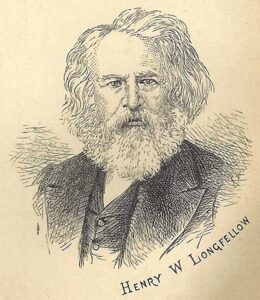
Henry Wadsworth Lonfellow, a distinguished American author both in prose and verse, was born in Portland, Maine, in 1807. Having studied at Bowdoin College, Brunswick, the poet, after three years travelling and residence in Europe, became Professor of Modern Languages in his native college. The appointment he held from 1829 to 1835, when he removed to the chair of Modern Languages and Literature in Harvard University, Cambridge.
While a youth at college, Mr. Longfellow contributed poems and criticisms to American periodicals. In 1833 he published a translation of the Spanish verses called Coplas de Manrique, accompanying the poem with an essay on Spanish poetry. In 1835 appeared his Outre-Mer, or Sketches from beyond Sea, a series of prose descriptions and reflections somewhat in the style of Washinton Irving.
His next work was also in prose, Hyperion, a Romance (1839), which instantly became popular in America. In the same year he issued his first collection of poems, entitled Voices of the Night. In 1841 appeared Ballads, and other poems; in 1842 Poems on Slavery; in 1843, The Spanish Student, a tragedy; in 1845, The Poets and Poetry of Europe; in 1846, The Belfry of Bruges; in 1847, Evangeline, a poetical tale in hexameter verse; in 1849, Kavanagh, a prose tale; and the Seaside and the Fireside, a series of short poems; in 1851, The Golden Legend, a medieval story in irregular rhyme; and in 1855, The Song of Hiawatha, an American-Indian tale, in a still more singular style of versification, yet attractive from its novelty and wild melody. Thus:
Ye who love the haunts of Nature,
Love the sunshine of the meadow,
Love the shadow of the forest,
Love the wind among the branches,
And the rain-shower and the snow-storm,
And the rushing of great rivers
Through their palisades of pine-trees,
And the thunder in the mountains,
Whose innumerable echoes
Flap like eagles in their eyries;
Listen to the wild traditions,
To this song of Hiawatha!
In 1858 appeared Miles Standish; in 1863, Tales of a Wayside Inn; in 1866, Flower de Luce; in 1867-70, a translation of Dante; New England Tragedies in 1869; in 1871, The Divine Tragedy, an unsuccesful drama, embodying incidents in the lives of John the Baptist and Christ; inn 1872, Three books of Song; in 1874, The Hanging of the Crane, and Aftermath; in 1875, the Masque of Pandora; in 1878, Kéramos; and in 1880 Ultima Thule. He also edited Poems and Places (31 vols), of which 2 vols. (England and Wales) were reprinted in London *1877).
Longfellow died March 24, 1882. He is beyond doubt the most popular of American poets. In none of his larger poems can be considered great, his smaller pieces are finished with taste, and all are inspired by healthy moral feeling and fine-toned humanity.
His poem Excelsior displays ’the life of a man of genius resisting all temptations,’ and pressing right on to accomplish his purpose.
The shades of night were falling fast,
As though an Alpine village passed
A youth, who bore, ‘mid snow and ice,
A banner with the strange device,
Excelsior!
His brow was sad; his eye beneath,
Flashed like a falchion from its sheath;
And like a silver clarion rung,
The accents of that unknown tongue,
Excelsior!
In happy homes he saw the light
Of household fires gleam warm and bright;
Above, the spectral glaciers shone,
And from his lips escaped a groan,
Excelsior!
‘Try not the Pass!’ the old man said;
‘Dark lowers the tempest overhead,
The roaring torrent is deep and wide!’
And loud the clarion voice replied,
Excelsior!
‘O stay,’the maiden sais, ‘and rest
thy weary head upon this breast!’
A tear stood in his bright blue eye,
But still he answered, with a sigh,
Excelsior!
‘Beware the pine-tree’s withered branch!
Beware the awful avalanche!’
This was the peasant’s last good-night.
A voice replied, far up the height,
Excelsior!
At break of day, as heavenward
The pious monks of Saint Bernard
Uttered the oft-repeated prayer,
A voice cried rthrough the startled air,
Excelsior!
A traveller, by the faithful hound,
Hald buried in the snow was found,
Still grasping in his hand of ice
That banner with the strange device,
Excelsior!
There in the twilight, cold and gray,
lifeless, but beautiful, he lay
And from the sky, serene and far,
A voice fell, like a falling star,
Excelsior!
A psalm of Life
Tell me not, in mournful numbers,
‘Life is but an empty dream!’
For the soul is dead that slumbers
And things are not what they seem.
Life is real! Life is earnest!
And the grave is not its goal;
‘Dust thou art, to dust returnest,
Was not spoken of the soul.
Not enjoyment, and not sorrow,
Is our destined end or way;
But to act, that each to-morrow
Find us farther than to-day.
Art is long, and Time is fleeting,
And our hearts, though stout and brave,
Still, like muffled drums, are beating
Funeral marches to the grave.
In the world’s broad field of battle,
in the bivouac of Life,
Be not like dumb, driven cattle;
Be a hero in the strife.
Trust no Future, howe’er pleasant!
Let the dead Past bury its dead!
Act – act in the living Present!
Heart within, and God o’erhead!
Lives of great men all remind us
We can make our lives sublime,
And, departing, leave behind us
Footr-prints on the sands of Time;
Foot-prints, that perhaps another,
Sailing o’er Life’s solemn main,
A forlorn and shipwrecked brother,
Seeing, shall take heart again.
Let us, then, be up and doing,
With a heart for any fate;
Still achieving, still pursuing,
Learn to labour and to wait.
The ladder of St. Augustine
Saint Augustine! well hast thou said,
That our vices we can frame
A ladder, if we will but tread
|Beneath our feet each deed of shame!
All common things, each day’s events,
That will the hour begin and end,
Our pleasures and our discontents,
Are rounds by which we may ascend.
The low desire, the base design,
That makes another virtues less;
The revel of the treacherous wine,
And all occasions of excess;
The longing for ignoble things;
The strife for triumph more than truth;
The hardening of the heart, that brings
Irreverence for the dreams of youth;
All thoughts of ill; all evil deeds,
That have their root in thoughts of ill;
Whatever hinders or impedes
The action of nobler will:
All these must first be trampled down
Beneath our feet, if we would gain
In the bright fields of fair renown
The right of eminent domain.
We have not wings, we cannot soar;
But we have feet to scale and climb
By slow degrees, by more and more,
The cloudy summits of our time.
The mighty pyramide of stone
That wedge-like cleave the desert airs,
When nearer seen and better known,
Are but gigantic flights of stairs.
The distant mountains, that uprear
Their solid bastions to the skies,
Are crossed by pathways, that appear
As we to higher levels rise.
The heights by great men reached and kept
Were not attained by sudden flight,
But they, while their companions slept,
Were toiling upward in the night.
Standing on what too long we bore
With shoulders bent and downcast eyes,
we may discern – unseen before –
A path to higher destinies.
Nor deem the irrevocable Past
As wholly wasted, wholly vain,
If, rising on its wrecks, at last
T something nobler we attain.
God’s-Acre
I like that ancient Saxon Phrase, which calls
The burial-ground God’s-Acre! it is just;
It consecrates each grave within its walls,
And breathes a benison o’er the sleeping dust.
God’s-Acre! Yes, that blessed name imparts
Comfort to shose who in the grave have sown
The seed that they had garnered in their hearts,
Their bread of life; alas! no more their own.
Into its furrows shall we all be cast,
In the sure faith that we shall ruse again
All the great harvest, when the archangel’s blast
Shall winnow, like a fan, the chaff and grain.
Then shall the good stand in immortal bloom,
In the fair gardens of that second birth;
And each bright’s blossom mingle its perfume
With that of flowers which never bloomed on earth.
With thy rude ploughshare, Death, turn up the sod,
And spread the furrow for the seed we sow;
This is the field and Acre of our God,
This is the place where human harvests grow!
Autumn in America
With what a glory comes and goes the year!
The buds of spring, those beautiful harbingers
Of sunny skies and cloudless times, enjoy
Life’s newness, and earth’s garniture spread out;
And when the silver habit of the clouds
Comes down upon the autumn sun, and with
A sober gladness the old year takes up
His bright inheritance of golden fruits,
A pomp and pageant fill the splendid scene.
There is a beatiful spirit breathing now
Its mellow richness on the clustered trees,
And, from a beaker full of richest dyes,
Pouring ne wglory on the autumn woods,
And dipping in warm light the pillowed clouds,
Morn on the mountains, like a summer bird,
Lifts up their purple wing; and in the vales
The gentle wind, a sweet and passionate wooer,
Kisses the blushing leaf, and stirs up life
Within the solemn woods af ash deep-crimsoned,
And silver beech, and maple yellow-leafed,
Where Autumn, like a faint old man, sits down
By the wayside aweary. Through the trees
The golden robin moves. The pruple finch,
That on wild cherry and red cedar feeds,
A winter bird, comes with its plaintive whistle,
And pecks by the witch-hazell whilst aloud
From cottage roofs the warbling blue-bird sings;
Amnd merrily. with oft repeated stroke,
Sounds from the threshing-floor the bury flail.
Oh, what glory doth this world put on
For him who with a fervent heart goes forth,
Under the bright and glorious sky, and looks
On duties well performed, and days well spent!
For him the wind, ay, and the yellow leaves,
Shall have a voice, and give him eloquent teachings;
He shall so hear the solemn hymn, that Death
Has lifted up for all, that shall go
To his long resting-place without a tear.