William Wordworth – as a poet
Onderstaand het artikel is afkomstig uit Chambers’s cyclopædia of English Literature, uitgebracht 1886.
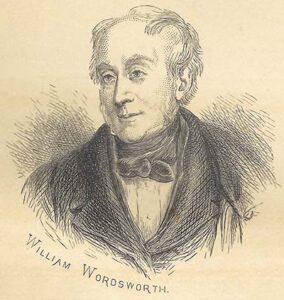
William Wordsworth, the most original of modern poets, was a native of Cockermouth, in the county of Cumberland, where he was born on the 7th of April 1770. His father was law-agent to Sir James Lowther, afterwards Earl of Lonsdale, but died when the poet was in his seventh year. William and hos brother – Dr Christopher Wordsworth, long master of Trinity College – after being some years at Hawkshead School, in Lancashire, were sent by their uncles to the university of Cambridge. William was entered of St. John’s in 1787. Having finished his academical course, and taken his degree, he travelled for a short time. In the autumn of 1790, he accomplished a tour on the continent in company with a fellow-student, Mr. Robert Jones. ‘We went staff in hand,’he said, ‘without knapsacks, and carrying each his needments tied up in a pocket handkerchief, with about £20 a piece in our pockets.’ With this friend, Wordsworth made a tour in North Wales the following year, after taking his degree in college. He was again in France towards the close of the year 1791, and remained in that country about a twelvemonth. He had hailed the French Revolution with feelings of enthusiastic admiration.
Bliss was it in that dawn to be alive,
But to be young was very heaven.
Few poets escaped the contagion. Burns, Coleridge, Southey, and Campbell all felt the flame, and looked for a new era of liberty and hapiness. It was long ere Wordsworth abandoned his political theory. His freiends were desirous he should enther the church, but his republican sentiments and the unsettled state of his mind rendered him averse to such a step. To the profession of the law he was equally opposed. Poetry was to be the sole business of his life. A young friend, Raisley Calvert, dying in 1795, left him a sum of £900. ‘Upon the interest of the £900,’ he says, £400 being laid out in annuity, with £200 deducted from the principal, and £100 more which the Lyrical Ballads brought me, my sister and I contrived to live seven years, nearly eight.’ A further sum of £1000 came to him as part of the estate of his father, who had died intestate; and with this small competence, Wordsworth devoted himself to study and seclusion. He first appeared as a poet in his tenwty-third year, 1793. The title of his work was Descriptive Sketches, which was followed the same year by Evening Walk. The walk is among the mountains of Westmoreland; the sketches refer to a tour made in Switzerland by the poet and his friend Jones. The poetry is of the style of Goldsmith; but description predominates over reflection. The enthusiastic dreams of liberty which then buoyed up the young poet, appear in such lines as the following:
O give, great God, to freedom’s waves to ride
Sublime o’ver conquest, avarice, and pride;
To sweep where pleasure decks het guilty bowers,
And dark oppression builds het thick-ribbed towers;
Give them, beneath their breast, while gladness springs,
To brood the nations o’ver with Nile-like wings;
And grant every sceptred child of clay
Who cries, presumpyuous, ‘Here their tide shall stay,’
Swept in their anger from the affrighted shore,
With all his creatures, sink to ride no more!
In the autumn of 1795, Wordswirth and his siter were settled at Racedown Lodge, near Crewkerne in Somersetshire, where they were visited in the summer of 1797 by Coleridge. The poets were charmed with each other’s society, and became friends for life. Wordsworth and his sister next moved to a resicence near Coleridge’s at Alfoxden, near Nether Stowey. At this place many of his smaller poems were written, and also a tragedy, the Borderers, which he attempted to get acted at Covent Garden Theatre, but it was rejected. In 1798, appeared the Lyrical Ballade, to which Coleridge contributed his Ancient Mariner. A generous provincial bookseller, Joseph Cottle of Bristol, gave thirty guineas for the copyright of this volume’he ventured on an impression of five hundred copies, but was soon glad to dispose of the largest proportion of the five hundred at a loss, to a London bookseller. The ballads were designed by their author as an experiment how far a simpler kind of poetry than that in use would afford permanent interest to readers. The humblest subjects, he contended, were fit for poetry, and the language should be that ‘really used by men.’ The fine fabric of poetic diction which generations of the tunefull tribe had been laboriously rearing, he proposed to destroy altogether. The language of humble and rustic life, arising out of repeated experience and regular feelings, he considered to be a more permanent and far more philosophical language than that which is frequently substituted for it by poets. The attempt of Wordsworth was either totally neglected or assailed with ridicule. The transition from the refined end sentimental school of verse, with select and polished diction, to such themes as The Idiot Boy, and a style of composition disfigured by colloquial plainness, and by the mixture of ludicrous images and associations with passages of tenderness and pathos, was too violent to escape ridicule or insure general success. It was often impossible to tell whether the poet meant to be comic or tender, serious or ludicrous; while the choice of his subjects and illustrations, instead of being regarded as genuine simplicity, had an appearance of silliness or affection. The faults of his wordt ballads were so glaring, that they overpowered, at least for a time, the simple natural beauties, the spirit of gentleness and humanity, with which they were accompanied. It was a first experiment, and it was made without any regard for existing prejudices or feelings, or any wish to concilate.
In 1798, Wordsworth, his sister, and Coleridge went to Germany, the latter parting frim them at Hamburg, and going to Ratzeburg, where he resided four months; while the Wordworths proceeded to Goslar, and remained there about half a year. On their return to England, they settled at Grasmere, in Westmoreland, where they lived for eight years. In 1800 he reprinted his Lyrical Ballads, with the addition of many new pieces, the work now forming two volumes. In October 1802, the poet was married to Mary Hutchinson, a lady with whom he had been early intimate, and on whom he wrote, in the third year of his married life, the exquisite lines, ‘She was a Phantom of Delight.’
She came, no more a Phantom to adorn
A moment, but an inmate of the heart,
And yet a spirit there for me enshrined
To penetrate the lofty and the low:
Even as one essence of parvading light
Shines in the brightest of ten thousand stars,
And the meek worm that feeds het lonely lamp
Couched in the dewey grass.
The prelude
In 1803, accompanied by Coleridge and his sister, Wordsworth made a tour in Scotland, which forms an epoch in his literary history, as it led to the production of some of his most popular minor poems. He had been for some years engaged on a poem in blank verse, which he brought to a close in 1805, but it wass not published till after his death. In 1805, also he worte his Waggoner, not published till 1819. Since Pope, no poet has been more careful of his fame than Wordsworth, and he was enabled to practise this abstinence in publication, because, like Pope, he was content with moderate means and limited desires. His circumstances, however, were at this time so favourable, that he purchased, for £1000, a small cottage and estate at the head of Ulleswater. Lord Lonsdale generously offered £800 to vomplete this purchase, but the poet accepted only a fourth of the sum. In 1807 appeared two volumes of Poems from his pen. They were assailed with all the severity of criticism, but it was seen that, whatever might be the theory of the poet, he possesed a vein of pure and exalted description and meditation which it was impossible not to feel and admire. The influence of nature upon man was his favourite theme; and though sometimes unintelligible from his idealism, he was also, on other occasions, just and profound. His worship of nature was ennobling and impressive. In 1809 the poet struck out into a new path. He came forward as a political writer, with an Essay on the Convention of Cintra, an event to which he was strongly opposed. His prose was as unsuccessful as his poetry, so far as sale was concerned; but there are fine vogorous passages in this pamphlet, and Canning is sais to have pronounced it the most eloquent production sonce the days of Burke. Wordsworth had now abandoned his republican dreams, and was hence-forward conservative of all time-honoured institutionsm in church and state. His views were never servile – they were those of a recluse politician, honest but ompractible. In the spring of 1813 occured Wordsworth’s removal from Grasmere to Rydal Mount, one of the grand events of his life; and there he resided for the long period of thirty-seven years – a period of cheerful and dignified poetical retirement –
Long have I loved what I behold,
The night that calms, the day that cheers;
The common growth of mother-earth
Suffices me – het tears, her mirth,
Her humblest mirth and tears.
The dragon’s wing, the magic ring,
I shall not covet for my dower,
If I along that lowly way
With sympathetic heart may stray,
And with a soul of power.
Prologue to ‘Petert Bell.’
The circle of his admirers was gradually extending, and he continued to supply it with fresh materials of a higher order. In 1814 appeared The Excursion, a philosophical poem in blank verse, by far the noblest production of the author, and containing passages of sentiment, description, and pure eloquence, not excelled by any living poet, while its spirit of enlightened humanity and Christian benevolence-extending over all ranks of sentient and animated being-imparts to the poem a peculiarly sacred and elevated character. The influence of Wordsworth on the poetry of his age has thus been as beneficial as extensive. He turned the public taste from pompous inanity to the study of man and nature; he banished the false and exaggerated style of character and emotion which even the genius of Byron stooped to imitate; and he enlisted the sensibilities and sympathies of his intellectual brethren in favour of the most expansive and kindly philanthropy. The pleasures and graces of his muse are all simple, pure, and lasting. In working out the plan of his Excursion, the poet has not, however, escaped from the errors of his early poems. The incongruity or want of keeping in most of Wordsworth’s productions is observable in this work. The principal character is a poor Scotch pedlar, who traverses the mountains in company with the poet, and is made to discourse, with clerk-like fluency,
Of truth, of grandeur, beauty, love, and hope.
It is thus that the poet violates the conventional rules of poetry and the realities of life; for surely it is inconsistent with truth and probability that a profound moralist and dialectician should be found in such a sitaution. In his travels with the ‘Wanderer’, the poet is introduced to a ‘Solitary,’ who lives secluded from the world, after a life of busy adventures and high hope, ending in disppointment and disgust. They all proceed to the house of the pastor, who – in the style of Crabbe’s Parish Register – recounts some of the deaths and mutations that had taken place in his sequestered valley; and with a description of a visit made by cludes. The Excursion is an unfinished work, part of a larger poem, The Recluse, ‘having for its principal object the sensations and opinions of a poet living in reitrement.’ The narrative part of The Excursion is a mere framework, rude and unskilful, for a series of pictures ot mountain scenery and philosophical dissertations, tending to shew how the external world is adapted to the mind of man, and good educed out of evil and suffering.
Within the soul a faculty abides,
That with interpositions, which would hide
And darken, so can deal, that they become
Contingencies of pomp, and serve to exalt
Het native brightness. As the ample moon
In the deep stillness of a summer even
Risong behind a thick lofty grove,
Burns like an uncomsuming fire of light
In the green trees; and, kindling on all sides,
Their leafy umbrage turns the dusky veil
Into a substance glorious as her own,
Yea, with her own incorporated, by power
Capacious and serene; like power abides
In a men’s celestial spirit; virtue thus
Sets forth and magnifies herself – thus feeds
A calm, a beautiful, and silent fire,
From the encumbrances of mortal life;
From error, disappointment – nay, from guilt;
And sometimes – so relenting justice wills –
From palpable oppressions of despair.
Book IV
In a stll loftier style of moral observation on the changes of life, the ‘gray-haired wanderer’ exclaims:
So fails, so languishes, grows dim, and dies,
All that this world is proud of. From their spheres
The stars of human glory are cast down;
Perish the roses and the flowers of kings,
Princes, and emperors, and the crowns and palms
Of all the mighty, withered and consumed I
Nor is power given to lowliest innocence
Long to protect her own. The man himself
Departs; and soon is spent the line of those
Who, in the bodily image, in the mind,
In heart or soul, in station or pursuit,
Did most resemble him. Degrees and ranks,
Fraternities and orders – heaping high
New wealth upon the burthen of the old,
And placing trust in privilege confirmed
And re-confirmed – are scoffed at with a smile
Of greedy foretaste, from the secret stand
Of desolation aimed; to slow decline
These yield, and these to sudden overthrow;
Their virtue, service, happiness, and state
Expire; and Nature’s pleasnt robe of green,
Humanity’s appointed shroud, enwraps
Their monuments and their memory.
Book VII
The picturesque parts of The Excursion are full of a quiet and tender beauty characteristic of the author. We subjoin two passages, the first descriptive of a peasant youth, the hero of his native vale:
A Noble Peasant
The mointain ash
No eye can overlook, when ‘mid a grove
Of yet unfaded trees she lifts het head
Decked with aurumnal berries, that outshine
Spring’s richest blossoms; and ye may have marked
By a brook side or solitary tarn,
How she het station doth adorn. The pool
Glows at her feet, and all the gloomy rocks
Are brightened round her. In this native vale,
Such and so glorious did this youth appear;
A sight that kindled pleasure in all hearts
By his ingenuous beauty, by the gleam
Of his fair eyes, by his capacious brow,
By all the graces with which nature’s hand
Had lavishly arrayed him. As old bards
Tell in their idle songs of wandering gods,
Pan or Apollo, veiled in human form;
Yet, like the sweet-breathed violet of the shade,
Discovered in their own despite to sende
Of mortals – if such fables without blame
May find chance mention on this sacred ground –
So through the impediment of rural cares,
In him revealed a scholar’s genius shone;
And so, not wholly hidden from men’s sight,
In him the spirit of a hero walked
Our unpretending valley. How the quoit
Whizzed from the stripling’s arm! If touched by him,
The inglorious football mounted to the pitch
Of the lark’s flight, or shaped a rainbow curve
Aloft, in prospect of the shouting field I
The indefatigable fox had learned
To dread his perseverance in the chase.
With admiration would he lift his eyes
To the wide-ruling eagle, and his hand
Was loath to assault the majesty he loved,
Else had the strongtest fastnesses proved weak
To guard the royal brood. The sailing glede,
The whelling swallow, and the darting snipe,
The sporting sea-gull dancing with the waves,
And cautious waterfowl from distant climes,
Fixed at their seat, the centre of the mere,
were subject to younf Oswald’s steady aim.
Book VII
The peasant youth, with others in the vale, roused by the cry to arms, studies the rudiments of war, but dies suddenly:
To him, thus snatched away, his comrades paid
A soldier’s honours. At his funeral hour
Bright was the sun, the sky a cloudless blue –
A golden lustre slept upon the hills;
And is by chance a stranger, wandering there,
From some commanding eminence had looked
Down on this spot, well pleased would have seen
A glittering spectacle; but every face
Was pallid – seldom hath that eye been moist
With tears that wept not then; nor were the few
Who from their dwellings came not forth to joint
In this sad service, less disturbed than we.
Theyr started at the tributary peal
Of instantaneous thunder which announced
Throught the still air the closing of the grave;
And distant mountains echoed with a sound
Of lamentation never heard before.
A description of deafness in a peasant would seem to be a subject hardly susceptible of poetical ornament; yet, by contrasting it with the surrounding objects – the pleasant wounds and stir of nature – and by his vein of pensive and graceful reflection, Wordsworth has made this one of his finest pictures.
The Deaf Dalesman
Almost at the root
Of that tall pine, the shadow of whose bare
And slender stem, while here I sit at eve,
Oft stretches towards me, like a long straight path
Traced faintly in the greensward; there, beneath
A plain blue stone, a gentle dalesman lies,
From whom in early childhod was withdrawn
The precious gift of hearing. He grew up
From year to year in loneliness of soul;
And this deep mountain valley was to him
Soundless, with all its streams. TThe bird of dawn
Did never roue this cottager from sleep
With startling Summons; not for his delight
The vernal cuckoo shouted; not for him
Murmured the labouring bee. When stormy winds
Were working the broad bosom of the lake
Into a thousand thousand sparkling waves,
Rocking the trees, or driving cloud on cloud
Along the sharp edge of yon lofty crags,
The agitated scene before his eye
Was silent as a picture: evermore
Were all things silent, wheresoeér he moved.
Yet, by the solace of his own pure thoughts
Upheld, he duteously pursued the round
Of rural labours; the steep mountain side
Ascended with his staff and faithful dog;
The plough he guided, and the scythe he swayed;
And the ripe corn before his sickle fell
Among the jocund reapers.
Book VII
By viewing man in connection with external nature, the poet blends his metaphysics with pictures of life and scenery. To bluid up and strengthen the powers of the mind, in contrast to the operations of sense, was ever his object. Like Bacon, Wordsworth would rahter have believed all the fables in the Talmud and Alcoran, than that this universal frame is without a mind – or that that mind does not, by its external symbols, speak to the human heart. HYe lived under the habutual ‘sway’ of nature:
To me the meanest flower that blows can give
thoughts that do often lie too deep for tears.
The removal of the poet to Rydal was marked by an incident of considerable importance in his personal history. Through the influence of the Earl of Lonsdale, he was appointed distributor of stamps in the county of Westmoreland, which added greatly to his income, without engrossing all his time. He was now placed beyond the frowns of Fortune – if Fortune can ever be said to have frowned on one so independent of het smiles. The subsequent works of the poet were numerous – The White Doe of Rylstone, a romantic narrative poem, yet coloured with his peculiar genius; Sonnets on the River Duddon; The Waggoner; Peter Bell; Ecclesiastical Sketches; Yarrow Reviseted; &c. Having made repeated tours in Scotland and on the continent, the poet diversified his subjects with descriptions of particular scenes, local manners, legends, end associations. The whole of his works were arranged by their author according to their respective subjects; as Poems referring to the Period of Childhood; Poems founded on the Affections; Poems of the Fancy; Poems of the Imagination, &c. This classification is often arbitrary and capricious; but it was one of the conceits of Wordsworth, that his poems schould be read in a certain continuous order, to give full effect to his system. Thus classified and published, the poet’s work formed six volumes. A seventh, consisting of poems written very early and very late in his life – as is stated – and the tragedy which had long lain past the author, were added in 1842. The tragedy is not happy, for Wordsworth had less dramatic power than any other contemporary poet. In the drama, however, both Scott and Byron failed; and Coleridge, with his fine imagination and pictorial expression, was only a shade more succesful.
The latter years of Wordsworth’s life were gladdened by his increasing fame, by academic honours conferred upon him by the universities of Durham and Oxford, by his appointment to the office od poet-laureate on the death of his friend Southey in 1843, and by a pension from the crown of £300 per annum. In 1847, he was shaken by a severe domestic calamity, the death of his only daughter, Dora, Mrs. Quillinan. This lady was worthy of her sire. Shortly before het death she published anonymously a Journal of a Residence in Portugal, whither she had gone in pursuit of health. Having attained to the great age of eighty, in the enjoyment of generally robust health (most of his poems were composed in the open air), Wordsworth died on the 23rd of April 1850 – the anniversary of St. George, the patron saint of England – and was interred by the side of his daughter in the beautiful churchyard of Grasmere.
One of the most enthusiastic admirers of Wordsworth was Coleridge, so long his friend and associate, and who looked up to him with a sort of filial veneration and respect. He has drawn his poeticasl character at length in the Biographia Literaria, and if we consider is as applying to the higher characteristics of Wordsworth, without reference to the absurdity of puerility of some of his early fables, incidents, and language, it will be found equally just and felicitous. First, ‘An austere purity of language, both grammatically and logiocally; in short, a perfect appropriateness of the words to the meaning. Secondly, A coorespondent weight and sanity of the toughts and sentiments won, not from books, but from the poet’s own meditations. They are fresh, and have the dew upon them. Even troughout his smaller poems, there is not one which is not rendered valuable by some just and original reflection. Thirdly, The sinewy strength anmd originality of single lines and paragraphs, the frequent curiosa felicitas of his diction. Fourthly, The perfect truth of nature in his images and descriptions, as taken immediatly from nature, and proving a long and genial intimacy with the very spirit which gives a physiognomic expression to all the works of nature. Fifthly, a meditative pathos, a union of deep and subtle thought with sensibility: a sympathy with man as man; the sympathy, indeed, of a comtemplator rather than a fellow-sufferer and co-mate (spectator, haud particeps), but of a contemplator from whose view no difference of rank conceals the sameness of the nature; no injuries of wind or wheather, or toil, or even of ingnorance, wholly disguise the human face divine. Last, and pre-eminently, I challenge for this poet the gift of imagination in the highest and strictest sense of the word. In the play of fancy, Wordsworth, to my feelings, is always graceful, and sometimes recondite. The likeness is occasionally too strange, or demands too peculiar a point of view, or is such as appears the creature of predetermined research, rather than spontaneous presentation. Indeed his fancy seldom displays itself as mere and unmodified fancy. But in imaginative power he stands nearest of all modern writers to Shakespeare and Milton, and yet in a mind perfectly unborrowed, and his own. To employ his own words, which are at once an instance and an illustrations, he does indeed, to all thoughts and to all objects –
Add the gleam
The light that never was on sea or land,
The consecration and the poet’s dream’.
The fame of Wordsworth was daily extending, as we have said, before his death. The few ridiculous or puerile passages which excited so much sarcasm, parody, and derision, had been partly removed by himself, or were by his admirers either quetly overlooked, or considered as mere idiosyncrasied of the poet that provoked a smile, while his higher attributes commanded admiration, and he had secured a new generation of readers. A tribe of worshippers, in the young poets of the day, had arisen to do him hommage, and in some instances they carried the feeling to a wild but pardonable excess. Many of his former depreciators also joined the ranks of his admirers – partly because in his late works the poet did himself more justice both in his style and subjects. He is too intelectual, and too little sensuous,, to use the phrase of Milton, ever to bvecome generally popular, unless in some of his smaller pieces. His peculiar sensibilities cannot be relished by all. His poetry, howeverm is of various kinds. Forgetting his own theory as to the proper subjects of poetry, he ventured on the loftiest themes, and in calm sustained elevation of thought, appropriate imagery, and intense feeling, he often reminds the reader of the sublime strains of Milton. His Laodamia, the Vernal Ode, the Ode to Lycoris and Dion, are pure and richly classic poems in conception and diction. Many of his sonnets have also a chaste and noble simplicity. In these short composition, his elevation and power as a poet are perhaps more remarkably displayed than in any of his other productions. They posses a winning sweetness or simple grandeur, without the most distant approach to antithesis or straining for effect; while that tendency to prolixity and diffuseness which characterises his longer poems, is repressed by the necessity for brief and rapid thought and concise expression, imposed by the nature of the sonnet. It is no exaggeration to say that Milton alone has surpassed – if even he was surpassed – some of the noble sonnets of Wordsworth dedicated to liberty an inspired by patriotism.
Sonnets
London, 1802
Milton! thou should be living at this hour;
England hath need of thee; she is a fen
Of stagnant waters; altar, sword, and pen,
Fireside, the heroic wealth of hall and bower
Have forfeited their ancient English dower
Of inward hapiness. We are selfish men;
Oh! raise ius up, return to us again;
And give is manners, virtue, freedom, power.
Thy soul was like a star, and dwelt apart;
Thou hadst a voice whose sound was lik the sea;
Pure as the naked heavens – majestic, free,
So didst thou travel on life’s common way
In cheerful godliness; and yet thy heart
The lowliest duties on herself didst lay.
The world is too much with us
The world is too much with us; late and soon,
Getting and spending, we lay waste our powers:
Little we see in nature that is ours;
We have given our hearts away, a sordid boon!
This sea that bares het bosom to the moon,
The winds that will be howling at all hours,
And are up-gathered now like sleeping flowers;
For this, for everything, we are out of tune;
It moves us not. Geart God! I’d rather be
A pagan suckled in a creed outworn;
So might I, standing on this pleasant lea,
Have glimpses that would make me less forlorn;
Have sight of Proteus coming from the sea;
Or hear old Triton blow his wreathed horn.
Composed upon Westminster Bridge, September 3, 1803.
Aerth has nothing to shew more fair:
Dull would he be of soul who could pass by
A sight so touching in its majesty:
This city now doth like a garment wear
The beauty of the morning; silent bare,
Ships, towers, domes, theatres, and temples lie
Open unto the fields and to the sky,
All bright and glittering in the smokeless air.
Never did sun more beautifully steep,
In his first splendour, valley, rock, or hill;
Ne’er saw I, never felt, a calm so deep!
The river glideth at his own sweet will:
Dear God! the very houses seem asleep;
And all that mighty heart is lying still!
On Kings College Chapel, Cambridge.
Tax not the royal saint with vain expense,
With ill-matched aims the architect who planned,
Albeit labouring for a scanty band
Of white-robed scholars only, this immense
And glorious work of fine intelligence!
Give all thou canst; high Heaven rejects the lore
Of nicely calculated less or more;
So deemed the man who fashioned for the sense
These lofty pillars, spread that branching roof
Self-poised, and scooped into ten thousand cells,
Where light and shade repose, where music dwells
Lingering – and wandering on, as loath to die;
Like thoughts whose very sweetness yieldeth proof
That they were born for immortality.
His Intimations of Immortality, and, Lines on Tintern Abbey, are the finest examples of his rapt imaginative style, blending metaphysical truth with diffuse gorgeous description and metaphor. His simpler effusions are pathetic and tender. He has little strong passion; but in one piece, Vaudracour and Julia, he has painted the passion of love with more warmth than might be anticipated from his abstract idealism:
His present mind
Was under fascination; het beheld
A vision, and adored the thing he saw.
Arabian fiction never filled the world
With half the wonders that were wrought for him
Earth breathed in one great presence of the spring;
Life turned the meanest of her implements
Before his eyes, to price above all gold;
The house she dwelt in was a sainted shrine;
Het chamber window did surpass in glory
The portals of the dawn; all paradise
Could, by the simple opening of a door,
Let itself in upon him; pathways, walks,
Swarmed with enchantment, till his spirit sank,
Surcharged within him – overblest to move
Beneath a sun that wakes a weary world
To its dull round of ordinary cares;
A man too happy for mortality!
The lovers parted under circumstances of danger, but had a stolen interview at night:
Through all her courts
The vacant city slept; the busy winds,
That keep no certain intervals of rest,
Moved not; meanwhile the galaxy displayed
Her fires, that like mysterious pulses beat
Aloft – momentous but uneasy bliss!
To their full hearts the universe seemed hung
On that brief meeting’s slender filament!
This is of the style of Ford or Massinger. Living mostly apart from the world, and nursing with solitary complacency his poetical system, and all that could bear upon his works and pursuits as a poet, Wordsworth fell into those erros of taste, and that whant of discrimination, to which we have already alluded. His most puerile ballads and attempts at humour were apparently as much prized by him, and classed with the same nicety and care, as the most majestic of his conceptions, or the most natural and beautiful of his descriptions. The art of condensation was also rarely practised by him. But if the poet’s retirement or peculiar disposition was a cause of his weakness, it was also one of the sources of his strength. It left him untouched by the artificial or meachanical tastes of his age; it gave an originality to his conceptions and to the whole colour of his thoughts; and it completely imbued him with that purer antique life and knowledge of the phenomena of nature – the sky, and mountains of his native district with such power and enthusiasm. A less complacent poet would have been chilled by the long neglect and ridicule he experienced. His spirit was self-supported, and his genius, at once observant and meditative, was left to shape out its own creations, and extend its sympathies to that world which lay beyond his happy mountain solitude.
Lines
My heart leaps up when I behold
A rainbow in the sky;
So was it when my life began;
So it is now I am a man;
So be it when I shall grow old,
Or let me die!
The child is father of the man;
And I could wish my days to be
Bound each to each by natural piety.
Lucy
She dwelt among the untrodden ways,
Beside the springs of Dove,
A maid whom there were none to praise,
And very few to love.
A violet by a mossy stone
Hald hidden from the eye;
Fair as a star, when only one
Is shining in the sky.
She lived unknown, and few could know
When Lucy ceased to be;
But she is in het grave, and oh,
The difference to me!
We are seven
A simple child, dear brother Jim,
That lightly draws its breath,
And feels its life in every limb,
What sould it know of death?
I met a little cottage girl;
She was eight years old, she said;
Het hair was thick with many a curl
That clustered round het head.
She had a rustic woodland air,
And she was wildly clad;
Her eyes were fair, and very fair –
Het beauty made me glad.
‘Sisters and brothers, little maid,
How many may you be?’
‘How many? Seven in all,’ she said,
And wondering looked at me.
‘And where are they? I pray you tell.’
She answered, ‘Seven are we;
And two of us at Conway dwell,
And two are gone to sea.
‘Two of us in the churchyard lie,
My sister and my brother;
And in the churchyard-cottage I
Dwell near them, with my mother.’
‘You say that two at Conway dwell,
And two are gone to sea,
Yet ye are seven! I pray you tell,
Sweet maid, how this may be?’
Then did the little maid reply,
‘seven boys and girls are we;
Two if us in the churchyard lie,
Beneath the churchyard tree.’
‘You run about, my little maid,
Your limbs they are alive;
If two are in the churchyard laid,
Then ye are only five.’
‘Their graves are green, they may be seen,’
The little maid replied,
‘Twelve steps or more from my mother’s door,
And they are side by side.
‘My stockings there I often knit,
My kerchief there I hem,
And there upon the ground I sit –
I sit and sing to them.
‘And often after sunset, sir,
When it is light and fair,
I take my little porringer,
And eat my supper there.
‘The first that dies was little Jane;
In bed she moaning lay,
Till God released her of her pain,
And then she went away.
‘So in the churchyard she was laid;
And when the grass was dry,
Together round her grave we played –
Mu brother John and I.
‘And when the ground was white with snow,
And I could run and slide,
My brother John was forced to go –
And he lies by her side.’
‘How many are you then,’ said I,
‘If they two are in heaven?’
The little maid did reply,
‘O master! we are seven.’
‘But they are dead; those two are dead!
Their spirits are in heaven!’
‘Twas throwing words away; for still,
The little maid would have her will,
And said, ‘Nay, we are seven!’
A portrait
She was a phantom of delight
When first she gleamed upon mu sight;
A lovely apparition, sent
To be a moment’s ornament;
Her eyes as stars of twilight fair;
Like twilight’s, too, het dusky hair;
But all things else about her drawn
From May-time and the cheerful dawn;
A dancing shape, an image gay,
To haunt, to startle, and waylay.
U saw upon nearer view,
A spirit, yet a woman too!
Het household motions light and free,
And steps of virgin liberty;
A countenance in which did meet
Sweet records, promises as sweet;
A creature not too brught or good
For human nature’s daily food;
For tansient sorrows, simple wiles,
Praise, blame, love, kisses, tears, and smiles.
And now I see with eye serene
The very pulse of the machine;
A being breathing thoughtful breath,
A traveller between life and death;
The reason firm, the temperate will,
Endurance, forosight, strength, and skill,
A perfect woman, nobly planned,
To warn, to comfort, and command;
And yet a spirit still, and bright
With something of an angel light.
Lines composed a few Miles above Tintern Abbey, on Revisiting the Banks of the Wye, during a tour, July 13, 1798.
Five years have passed; five summers, with the length
Of five long winters; and again I hear
These waters, rolling from their mountain springs
With a sweet inland murmur, Once again
Do I behold these steep and lofty cliffs,
That on a wild secluded scene impress
Thoughts of more deep seclusion, and connect
The landscape with the quiet of the sky.
The day is come when I again repose
Here, under this dark sycamore, and view
These plots of cottage ground, these orchard tufts,
Which, at this season, with their unripe fruits,
Are clad in one green hue, and lose themselves
Among the woods and copses, nor disturb
The wild green landscape. Once again I see
These hedgerows, hardly hedgerows, little lines
Of sportive wood run wild; these pastoral farms
Green to the very door; and wreaths of smoke
Sent up in silence from among the trees!
With some uncertain notice, as might seem,
Of vagrant dwellers in the houseless woods,
Or of some hermit’s cave, where, by his fire,
The hermit sits alone.
These beautous forms,
Through a long absence, have not been to me
As is a landscape to a blind man’s eye:
But oft, in lonely rooms, and ‘mid the din
Of towns and cities, I have owed to them,
In hours of weariness, sensations sweet,
Felt in the blood, and felt along the heart,
And passing even into my purer mind
With tranquil restoration: fellings, too,
Of unremembered pleasure; such, perhaps,
As may have had no trivial influence
On that best portion of a good man’s life,
His little, nameless, unremembered acts
Of kindness and love. Nor less, I trust,
To them I may have owed another gift,
Of aspect more sublime; that blessed mood
in which the burthen of the mystery,
In which the heavy and the weary weight
Of all this unintelligible world
Is lightened; that serene and blessed mood
In which the affections gently lead us on,
Until the breath of this corporeal frame,
And even the motion of out human blood
Almost suspended, we are laid asleep
In body, and become a living soul:
While with an eye made quiet by the power
Of harmony and the deep power of joy,
We see into the life of things.
If this
Be but a vain belief, yet oh! how oft
In darkness, and amid the many shapes
Of joyless daylight, when the fretful stir
Unprofitable, and the fever of the world,
Have hung upon the beatings of my heart,
How oft in spirit have I turned to thee,
A sylvan Wye! – thou wanderer through the woods –
How often has my spirit turned to thee!
And now, with gleams of half-extinguished thought,
With many recognitions dim and faint,
And somewhat of a sad perplexity,
The picture of the mind revives again:
While here i Stand, not only with the sense
Of present pleasure, but with pleasing thoughts,
That in this moment there is life and food
For future years. And so I dare to hope,
Though changed, no doubt, from what I was when first
I came among these hills; when, like a roe,
I bounded o’er the mountains, by the sides
Of the deep rivers, and the lonely streams,
Wherever nature led: more like a man
Flying from something that he dreads, than one
Who sought the thing he loved. For nature then –
The coarser pleasures of my boyish days
And their glad animal movements all gone by –
To me was all in all. I cannot paint
What then I was. The sounding cataract
Haunted me like a passion; the tall rock,
The mountain, and the deep and gloomy wood,
Their colours and their forms, were then to me
An appetite; a feeling and a love
That had no need of a remoter charm,
By thought supplied, or any interest
Unborrowed from the eye. That time is past,
And all its aching joys are now not more,
And all its dizzy raptures. Not for this
Faint I, not mourn, nor murmur; other gifts
Have followed, for such loss, I would belive,
Abundant recompense. For I have learned
To look on nature, not as in the hour
Of thoughtless youth, but hearing oftentimes
The still sad music of humanity,
Nor harsh nor grating, though of ample power
To chasten and subdue. And I have felt
A presence that disturbs me with joy
Of elevated thoughts; a sense sublime
Of something far more deeply interfused,
Whose dwelling is the light of setting suns,
And the round ocean, and the living air,
And the blue sky, and in the mind of man;
A motion and a spirit that impels
All thinking things. Therefor am I still
A lover of meadows and the woods
And mountains, and of all that we behold
From this green earth; of all the mighty world
Of an eye and ear, both what they half create
And what perceive; well pleased to recognise
In nature, and the language of the sense,
The anchor of my purest thoughts, the nurse,
The guide, the guardian of my heart, and soul
Of all my moral being.
Nor, perchance,
If I were not thus taught, should I the more
Suffer my genial spirits to decay:
For thou art with me here, upon the banks
Of this fair river; thou, me dearest friend,
My dear, dear friend, and in thy voice I catch
The language of my former heart, and read
My former pleasures in the shooting lights
Of thy wild eyes. Oh! yet a little while
May I behold in thee what I was once,
My dear, dear sister! And this prayer I make,
Knowing that nature never did betray
The heart that loved her; ’tis her privilege,
Through all the years of this our life, to lead
From joy to joy; for she can so inform
The mind that is within us, so impress
With quietness and beauty, and so feed
With lofty thoughts, that neither evil tongues,
Rasj judgments, nor the sneers of selfish men,
Nor greetings where no kindness is, nor all
The dreary intercourse of daily life,
Shall e’er prevail against us, or disturb
Our cheerful faith that all which we behold
Is full of blessings. Therefore let the moon
Shine on thee in thy solitary walk;
And let the misty mountain winds be free
To blow agianst thee: and in after years,
When these wild ectasies shall be matured
Into a sober pleasure, when thy mind
Shall be a mansion for all lovely forms,
Thy memory be as a dwelling place
For all sweet sounds and harmonies; oh! then,
If solitude, or fear, or pain, or grief,
Should be thy porion, with what healing thoughts
Of tender joy wilt thou remember me,
And these my exhortations! Nor, perchance,
If I should be where I no more can hear
Thy voice, nor catch from thy wild eyes these gleams
Of past existence, wilt thou then forget
That on the banks of this delightful stream
We stood together; and that I, so long
A worshipper of nature, hother came,
Unwearied in that service: rahter say
With warmer love, oh! with far deeper zeal
Of holier love. Nor wilt thou then forget,
That after many wanderings, many years
Of absence, these steep woods and lofty cliffs,
And this green pastral landscape, were to me
More dear, both from themselves and for thy sake!
Picture of Chrismas-Eve.
Adressed to the Rev. Dr. Wordsworth, with Sonnets to the River Duddon &c.
The minstrels played their Christmas tune
To-night beneath my cottage eaves:
While smitten by a lofty moon,
The encircling laurels, thick with leaves,
Gave back a rich and dazzling sheen,
That overpowered their natural green.
Through hill and valley every breeze
Had sunk to rest with folded wings;
Keen was the air, but could not freeze,
Nor check the music of the strings;
So stout and hardy were the band
That scraped the chords with strenuous hand.
And who but listened till was paid
Respect to every inmate’s calaim;
The greeting given, the music played
In honour of each household name,
Duly pronounced with lusty call,
And ‘merry Christmas’ wished to all?
O brother! I reverse the choice
That took thee from thy native hills;
And it is given thee to rejoice:
Though public care full often tills –
Heaven only witness of the toil –
A barren and ungrateful soil.
Yet, would that thou, with me and mine,
Hadst heard thius never-failing rite;
And seen on other faces shine
A true revival of the light
Which nature, and these rustic powers,
In simple childhood spread through ours!
For pleasure hath not ceased to wait
On these expected annual rounds,
Wheter the rich man’s sumptuous gate
Call forth the unelaborate sounds,
Or they are offered at the door
That guards the lowliest of the poor.
How touching, when at midnight sweep
Snow-muffled winds, and all is dark,
To hear – and sink again to sleep!
Or, at an earlier call, to mark,
By blazing fire, the still suspense
Of self-complacent innocence;
The mutual nod – the grave disguise,
Of hearts with gladness brimming o’er;
And some unbidden mtears that rise
For names once heard, and heard no more;
Tears brightened by the serenade
For infant in the cradle laid!
Ah! not for emerald fields alone,
With ambient streams more pure and bright
Than fabled Cytherea’s zone
Glittering before the Thunderer’s sight,
Is to my heart of hearts endeared
The ground where we were born and reared!
Hail, ancient manners! sure defence,
Where they survive, of wholesome laws;
Temnants of love, whose modest sense
Thus into narrow room withdraws;
Hail, usages of pristine mould,
And ye that guard them, mountains old!
Bear with me, brother, quench the tought
That slights this pasison or condemns;
If thee fond fancy ever brought
From the proud margin of the Thames,
And Lambeth’s venerable towers,
To humbler streams and grenner bowers.
Yes, they can make, who fail to find
Short leisure even in busiest days,
Moments – to cast a look behind,
And profit by those kindly rays
That through the clouds do sometimes steal,
And all the far-off past reveal.
Hence, while the imperial city’s din
Beats frequent on thy satiate ear,
A pleased attention I may win
To agitations less severe,
That neither overwhelm nor cloy,
But fill the hollow vale with joy.
To a Highland girl
At Inversneyd, upon Loch Lomond.
Sweet Highland girl, a very shower
Of beauty is thy erthly dower!
Twice seven consenting years have shed
Their utmost bounty on thy head:
And these ghrey rocks; this household lawn;
These trees, a veil just half withdrawn;
This fall of water, that doth make
A murmur near the silent lake;
This little bay, a quiet road
That holds in shelter thy abode –
In truth, together do ye seem
Like something fashioned in a dream;
Such forms as from their covert peep
When earthly cares are laid asleep!
Yet, dream or vision as thou art,
I bless thee with a human heart!
God shield thee to thy latest years!
I neither know thee nor thy peers;
And yet my eyes are filled with tears.
With earnest feeling I shall pray you
For thee when I am far away:
For never saw I mien or face,
In which more plainly I could trace
Benignity and homebred sense
Ripening in perfect innocence.
Here scattered, like a random seed,
Remote from men, thou dost not need
The embarassed look of shy distress
And maidenly shamefacedness:
Thou wear’st upon thy forehead clear
The freedom of a mountaineer:
A face with gladness overspread!
Soft smiles, by human kindness bred!
And seemliness complete, that sways
Thy courtesies, about thee plays;
With no restraint, but such as springs
From quick and eager visitings
Of thoughts that lie beyond the reach
Of thy few words of English speech:
A bondage sweetly brooked, a strife
That gives thy gestures grace and life!
So have I, nor unmoved in mind,
Seen birds of tempest-loving kind,
Thus beating up against the wind.
What hand but would a garland cull
For thee who art so beautiful?
O happy pleasure! here to dwell
Beside thee in some heathy dell;
Adopt your homely ways, and dress
A shepherd, thou a shepherdess!
But I could frame a wish for thee
More like a grave reality:
Thou art to me but of common neighbourhood.
What joy to hear thee, and to see!
Thy elder brother I would be –
Thy father – anything to thee!
Now thanks to heaven! that of its grace
Hath led me to this lonely place.
Joy have I had; and going hence,
I bear away mu recompense.
In spots like these it is we prize
Our memory, feel that she hath eyes:
Then, why should I be loath to stir?
I feel this place was made for her;
To give me new pleasure like the past,
Continued long as life shall last.
Nor am I loath, though pleased at heart,
Sweet Highland girl! from thee to part;
For I, methinks, till I grow old,
As fair before me shall behold,
As I do now, the cabin small,
The lake, the bay, the waterfall;
And thee, the spirit of them all!
Laodamia
‘With sacrifice before the rising morn,
Vows have I made by fruitless hope inspired;
And from the infernal gods, ‘mid shades forlorn
Of night, my slaughtered lord have I required:
Celestial pity I again implore;
Restore him to my sight – great Jove, restore!
So speaking, and by fervent love endowed
With faith, the suppliant heavenward lifts her hands;
While, like the sun emerging from a cloud,
Her countenance brightens and her eye expands;
Her bosom heaves and spreads, her stature grows;
And she expects the issue in repose.
O terror! what hath she perceived? – O joy!
What doth she look on? – whom doth she behold?
Her hero slain upon the beach of Troy?
His vital presence? his corporeal mould?
It is – if sense deceive her not – ’tis he!
And a god leads him, winged Mercury!
Mild Hermes spake, and touched het with his wand
That calms all fear: ‘Such grace hath crowned thy prayer,
Laodamia! that at Jove’s command
The husband walks the path of upper air;
He comes to tarry with thee three hours’ space;
Accept the gift; behold him face to face!
Forth sprang the impassioned queen her lord to clasp,
Again that consummation she essayed;
But unsubstantial Form eludes het grasp
As often as that eager grasp was made.
The phantom parts – but parts to reunite,
And reassume his place before her sight.
‘Protesiláus, lo! thy guide is gone!
Confirm, I pray, the vision with thy voice.
This is our palace – yonder is thy throne;
Speak, and the floor thou tread’st on will rejoice.
Not to appal me have the gods bestowed
This precious boon; and blest a sad abode.’
‘Great Jove, Laodamia, doth not leave
His gifts imperfect. Spectre though I be,
I am not sent to scare thee or deceive;
But in reward of thy fidelity.
And something also did my worth obtain;
For fearless virtue bringeth boundless gain.
‘Thou knowest, the Delphic oracle foretold
That the first Greek who touched the Trojan strand
Shoul die: but me the thread could not withhold:
A generous cause a victim did demand;
And forth I leapt upon the sandy plain;
A seld-devoted chief – by Hector slain.’
‘Supreme of heroes; bravest, noblest, best!
Thy matchless courage I bewail no more,
Which then, when tens of thousands were depressed
By doubt, propelled thee to the fatal shore;
Thou found’st – and I forgive thee – here thou art –
A nobler counsellor than my poor heart.
‘But thou, though capable of sternest deed,
Wert kind as resolute, and good as brave;
And he, whose power restores thee, hath decreed
That thou shouldst cheat the malice of the grave.
Redundant are thy locks, the lips as fair
As when their breath enriched Thessalian air.
‘No spectre greets me – no vain shadow this;
Come, blooming hero, place thee by my side!
Give, on this well-known couch, one nuptial kiss
To me, this day, a second time thy bride!’
Jove frowned in heaven; the conscious Parcæ threw
Upon those roseate lips a Stygian hue.
This visage tells thee that my doom is past;
Nor should the change be mourned, even if the joys
Of sense were able to return as fast
And surely as they vanish. Earth destroys
Those raptures duly – Erebus disdains;
Calm pleasures there abide – majestic pains.
‘Be taught, O faithful consort, to control
Rebellious passion; for the gods approve
The depth, and not the tumult, of the soul;
A fervent, not ungovernable love.
Thy transport moderate; and meekly mourn
When I depart, for brief is my sojourn.
‘Ah, wherefore? Did not Hercules by force
Wrest from the guardian monster of the tomb
Alcestis, a reanimated corse,
Given back to dwell on earth in vernal bloom?
Medea’s spells dispersed the weight of years,
And Æson stood a youth ‘mid youthful peers.
‘The gods to us are merciful; and they
Yet further may relent; for mightier far
Than strength of nerve and sinew, or the sway
Of magic potent over sun and star,
Is love, though oft to agony distressed,
And though his favourite seat be feeble woman’s breast.
‘But if thou goest, I follow.’ ‘Peace!’ he said;
She looked upon him, and was calmed and cheered;
The ghastly colour from his lips had fled.
In his deportment, shape, and mien appeared
Elysian beauty, melancholy grace,
Brought from a pensive though a happy place.
He spake of love, such love as spirits feel
In worlds whose course is equable and pure;
No fears to beat away, no strife to heal,
The past unsighted for, and the future sure;
Spake of heroic arts in graver mood
Revived, with finer harmony purued.
Of all that is most beauteous – imaged there
In happier beauty; more pellucid streams,
An ampler ether, a diviner air,
And fields invested with purpureal gleams;
Climes which the sun, who sheds the brightest day
Earth knows, is all unworthy to survey.
Uet there the soul shall enter which hath earned
That privilege by virtue. ‘Ill,’ said he,
“the end of man’s existence I discerned,
Who from ignoble games and revelry
Could draw, when we had parted, vain delight,
While tears were thy best pastime, day and night:
‘And while my youthful peers before my eyes –
Each hero following his peculiar bent –
Oreoared themselves for glorious enterprise
By martial sports; or seated in the tent,
Chieftains and kings in council were detained –
What time the fleet at Aulis lay enchained.
‘The wished-for wind was given: I then revolved
The oracle upon the silent sea;
And, if no worthier led the way, resolved
That, of a thousand vessels, mine should be
The foremost prow in pressing to the strand –
Mine the first blood that tinged the Trojan sand.
‘Yet bitter, ofttimes bitter was the pang,
When of thy loss I thought, beloved wife!
On thee too fondly did my memory hang,
And on the joys we shared in mortal life;
The paths which we had troth – these fountains, flowers;
My new-planned cities, and unfinished towers.
‘But should suspense permit the foe to cry,
“Behold they tremble! haughty their array;
Yet of their number no one dares to die!”
In soul I sweptthe indignity away:
Old frailties then recurred; but logty thought
In act embodied, my deliverance wrought.
‘And thou, though strong in love, art all too weak
In reason, in self-government too slow;
I counsel thee by fortitude to seek
Our blest reunion in the shades below.
The invisible world with thee hath sympathised;
By the affections raised and solemnised.
‘Learn, by a mortal yearning, to ascend –
Seeking a higher object. Love was given,
Encouraged, sanctioned, chiefly for that end;
For this the passion to excess was driven,
That self might be annuled: her bondage prove
The fetters of a dream, opposed to love.
Aloud she shrieked; for Hermes reappears!
Rounbd the dear shade she would have clung: ’tis vain;
The hours are past – too brief had they been years;
And him no mortal effort can detain:
Swift toward the realms that know not earthly day,
He trough the portal takes his silent way,
And on the palace-floor a lifeless corse she lay.
By no weak pity might the gods be moved;
She who thus perished, not without the crime
Of lovers that in reason’s spite have loved,
Was doomed to wear out het appointed time
Apart from happy ghosts, that gather flowers
Of blissful quiet ‘mid unfading bowers.
– Yet tears to human suffering are due;
And mortal hopes defeated and o’verthrown
Are mourned by man, and not by man alone,
As fondly he believes. Upon the side
Of Hellespont (such faith was entertained)
A knot of spiry trees for ages grew
From out the tomb of him for whom she died;
And ever, when such stature they had gained,
That Ilium’s walls were subject to their view,
The trees’ tall summits withered at the sight –
A constant interchange of growth and blight!
Memoirs of Wordswoth, by the poet’s nephew, Christopher Wordsworth, D.D., appeared in 1851. Recollections of a Tour in Scotland, A.D. 1803, by Dorothy Wordsworth, the poet’s sister, to whose talents and devoted affection het brother was indebted, appeared in 1874. His prose works have been edited by the Rev. A. Grosart (1876); Matthew Arnold edited a selection of his poems, with critical preface (1879); there is a monograph Wordsworth by F.W. Myers (1880); and Professor Knight has edited an elaborate and complete edition of his Poems, vols. i. and ii. (1882).